
The Journal
Alumni and Campus News


Maris Kaiser ’22
Maris Kaiser ’22
Selling sales
Alumna shares career insight with former class
One of the value-added aspects of being a Marietta College student is the strong connection they have with the alumni base, who are readily willing to share insights into specific professions and extend support when entering the workforce.
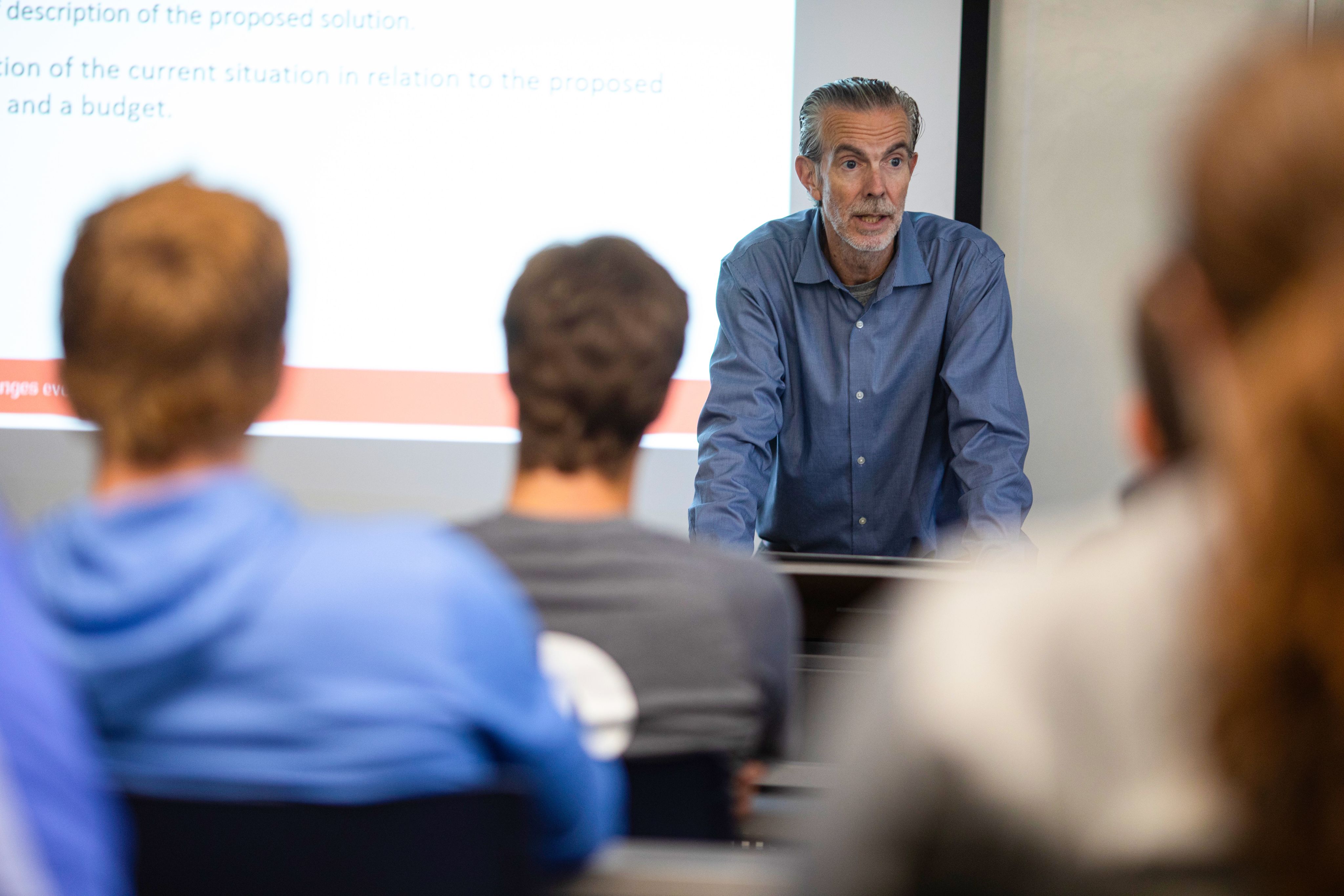
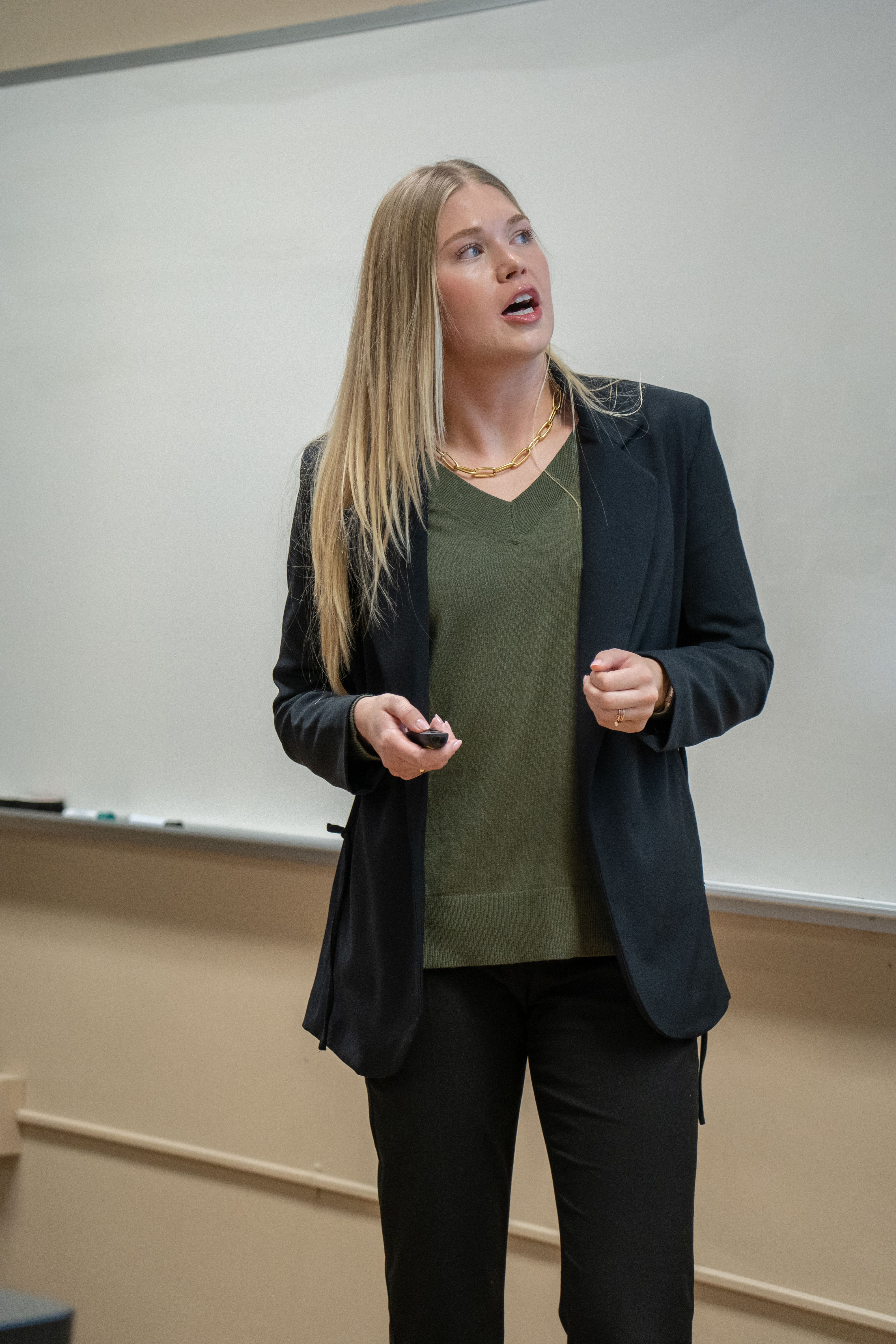
Maris Kaiser ’22 recently returned to campus to speak with Joe Bergin’s Principles of Selling class. Kaiser began working in sales for Cintas Corporation shortly after graduating.
“I took Joe’s class when I was a senior and we kept a good relationship through my graduation. I would just inform him on the professional career,” Kaiser says. “I was so honored when he asked me to come in and speak to his students like someone did for me when I was in his class.”
In addition to talking to students about finding a rewarding job as a sales representative, Kaiser provided a space for students to ask her about working in a competitive market.
“I also want them to know that they can use me as a resource in the future when they are entering into their professions,” Kaiser says. “I learned early on how valuable it is to have the types of connections that being a Marietta College graduate comes with, so I’m sharing that with Joe’s class, as well.”
Bergin ’86 worked in sales for 23 years and has been the men’s soccer coach and a faculty member in the Business & Economics Department at Marietta for the past 11 years.
“I want my students to know that you can make a very good living in sales, and Maris can talk to them about the monetary side of things,” Bergin says. “With the liberal arts education they receive at Marietta — especially with the focus on communication — our students can really thrive in sales.”
Bergin earned a B.A. in Journalism from Marietta and worked for the 3M Company as an account executive — with The Home Depot being his largest account.
“I always say that the best class I ever took here was Speech 101,” Bergin says. “It was hard when you’re a freshman, but without it, I could never have gotten in front of this class or in front of my team, or in front of The Home Depot buyers. That’s what the liberal arts did for me.”
GI SMITH
A popular accounting professor is now a
popular music professor
How does a retired Marietta College accounting professor re-invent himself as an instructor of popular music? Through the Institute of Learning in Retirement (ILR)! Dr. Ed Osborne, Professor Emeritus of Accounting who retired in 2008 after a 40-year teaching career, has since been offering classes on modern musical genres and the popular music of recent decades.
This February, Ed is teaching his fifth music class for the ILR, this time about the Music of the 1970s. The class focuses on The Eagles, ABBA, The Bee Gees, and Creedence Clearwater Revival. In his class, Ed covers the history of each group including biographical information about each member. The class listens to music and watches documentary film clips. There is a waiting list for the class; 60 students have been registered for the class for over a month.
In reflecting on why his classes are so popular, Ed surmises that the students that the ILR attracts are as interested in being entertained as in being instructed. Most also lived through the time period being studied and so are familiar with the music. But another factor is that Ed is very much at ease in front of a classroom. “I like to do research and have a lot of experience with it,” he says.
Ed started teaching ILR classes the year he retired. His first class was a team-taught overview of music genres, including Jazz, Blues, Swing, and Pop. His other co-instructors were Mark Neyman, Art Jones, and John Michel. Ed focused on the Blues.
Ed began listening to the Blues as a 12-year-old in Connersville, Indiana. One of the two night-time radio stations there played Blues exclusively. Later, while working as a CPA with Arthur Andersen in Chicago, Ed had opportunities to meet some of the Blues musicians he had been listening to for years. Though he is not a musician and has never taken music classes himself, he loves listening to music and digging into the people and events behind it.
Besides classes on the Blues, Ed has taught classes on the Music of the 1960s and co-taught a class with Dr. Dave Cress on Broadway Music of the 1950s. He has also served for four years as Treasurer of ILR.
At 81 years of age, Ed does not know how many more music classes are in his future. He’s considering requests to repeat some of the classes he’s offered in the past. If so, be sure to sign up early. Ed’s classes fill up quickly!
MJ EBENHACK

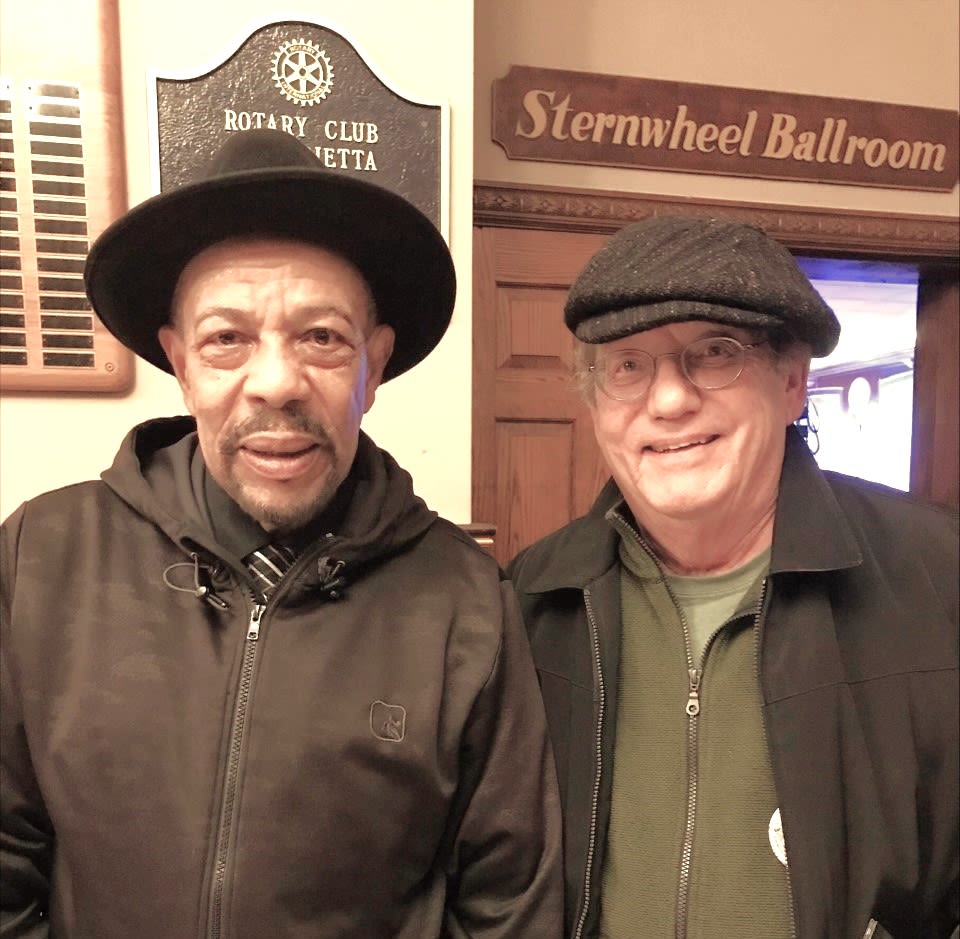
Blues legend John Primer and Professor Emeritus Dr. Ed Osborne
Blues legend John Primer and Professor Emeritus Dr. Ed Osborne
Learn more about Institute of Learning in Retirement.
Another Success
Hundreds of students, faculty, staff, and community members enjoyed the College's Lunar New Year and Multicultural Festival earlier this month.

Putting their education and math skills to the test
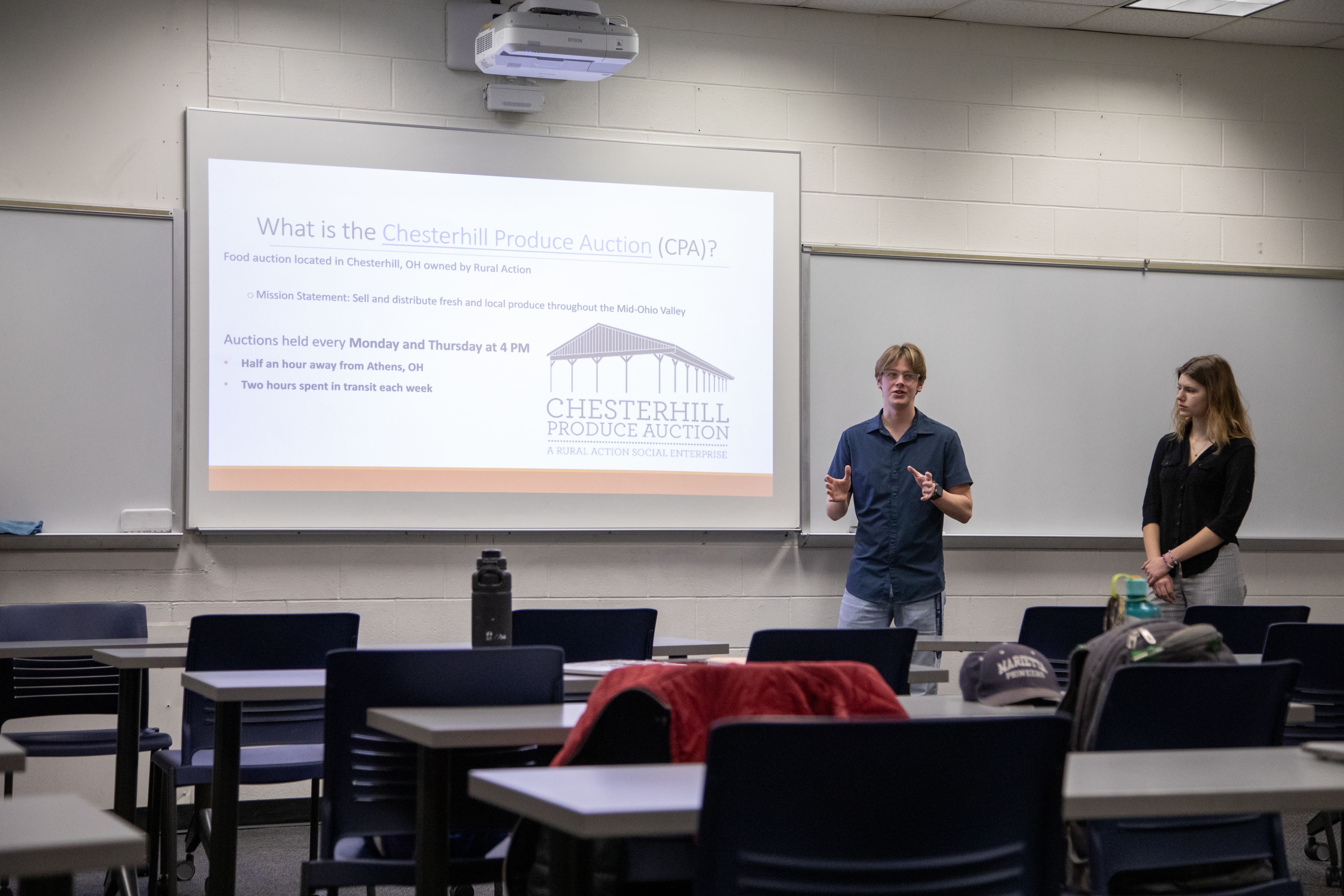
Five students from four different academic backgrounds have come together this semester to use their math skills to help solve a significant problem for a local food insecurity nonprofit.
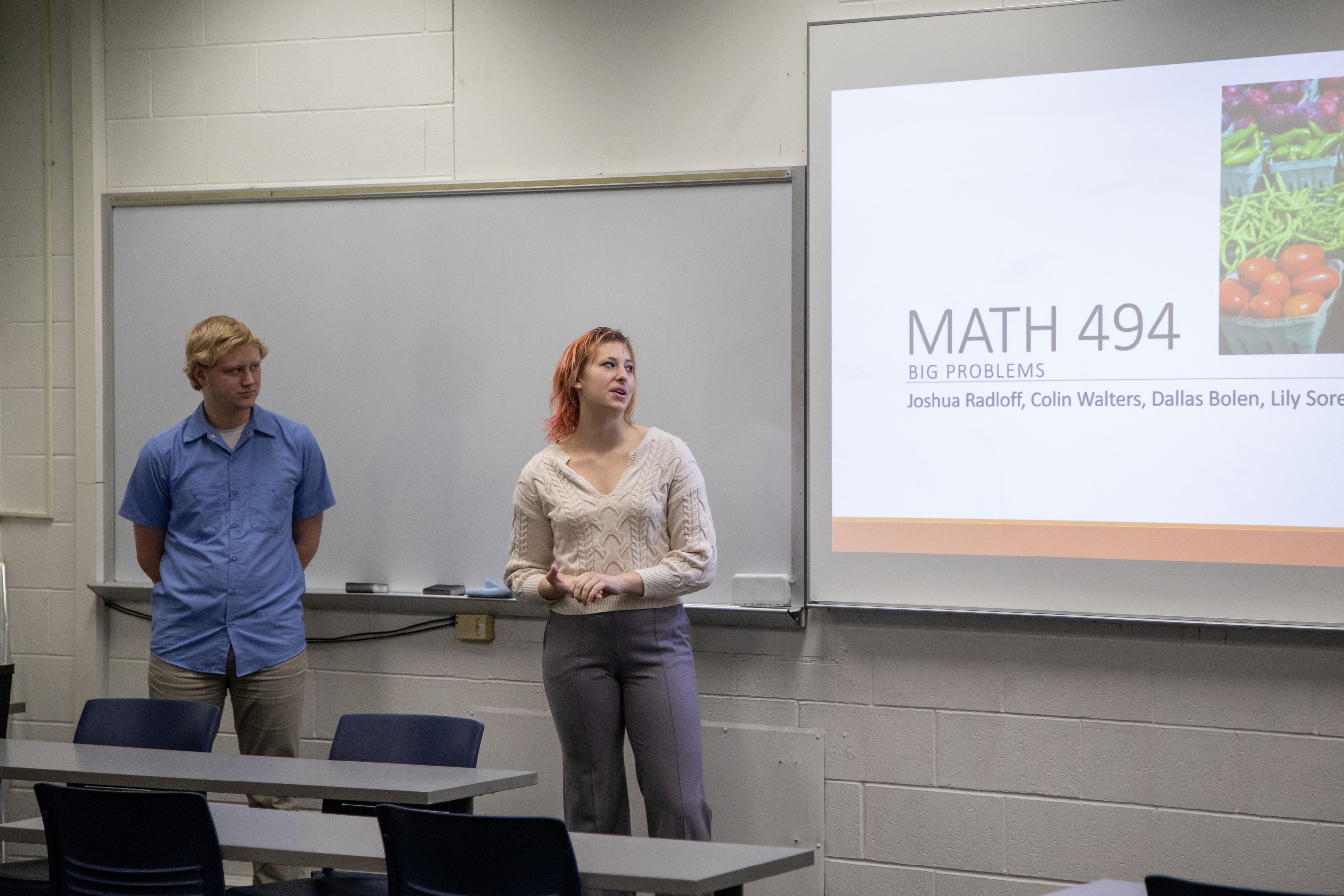
As part of the PIC (Preparation for Industrial Careers) Math program, Morgan Szucs ’24, Lily Sorensen, Joshua Radloff ’25, Colin Walters ’25, and Dallas Bolen ’27 were selected by Assistant Math Professor Michelle Jeitler to help Community Food Initiatives (CFI) solve an efficiency problem.
“The problem that we have collectively decided is to help solve is that CFI does not have a method of measuring how much they bid on produce at CPA (the Chesterhill Produce Auction) to have a sustainable business practice,” says Dallas Bolen ’27, a Biochemistry major and a College Credit Plus student. CPA is one of the suppliers of produce for CFI’s food distribution program. “Exactly what range or what amount do they need to bid for specific produce items so that they can go in and know that they’re not going to (overbid) and run in the negative. The solution that we are going to come up with is to create a resource based on past data that can allow anyone from CFI to bid on and purchase produce in a thrifty and sustainable way.”
Jeitler applied to the PIC Math program, which is run by the Mathematics Association of America, and was one of 14 professors nationally to be accepted.
“The program helps you develop and design a mathematics course that pairs with an industry/non-profit/government organization to help them solve a problem using mathematics,” Jeitler says. “The program is designed to help students understand the real-world applications and careers in mathematics.”
During a routine presentation, the group discussed the progress they have made in understanding the obstacles that the Athens-based non-profit faces when purchasing and distributing produce to underserved people in the region. CFI offers an array of services aimed at addressing food insecurity. The student group chose to analyze facets: the Donation Station and the Veggie Van.
“The Donation Station started in 2007,” says Szucs. She and Sorensen are Actuarial Science majors. “With the help of farmers, vendors, and organizations, they are working to fill the gap of food insecurities throughout the MOV. It’s a food bank that runs 12 months a year and has 40 to 50 partners. Veggie Van started in 2020, and it provides produce to underserved communities. It is a mobile farmstand and it is donation-based. The prices are not set — it’s pretty much a ‘give what you can’ mobile farmstand that runs seven months a year.”
Radloff, who is an Education (Adolescent/Youth Adolescent – Math) major, says the data provided to their group by the non-profit covers multiple years and a range of services, which presented their first challenge.
“This is a ton of data to look at, so we’re going to organize it to look at averages, means, produce prices and stuff like that,” Radloff says. “We may look into using some AI (artificial intelligence) to help us process this data because it’s a lot to do by hand and I don’t think we could get it all done this year. We’re looking at different ways to organize this data and then create a master Excel sheet for each different folder.”
Additionally, the group plans to look at other potential data streams, including the types and fuel efficiency of the vehicles being driven to the Chesterhill Produce Auction (CPA), and the wages of the workers. From the Athens pantry, the auction location is about a one-hour, round-trip drive.
“We are working with this raw, itemized data to figure out a way to maximize the purchasing power of what we’re going to get at the CPA, but also minimize travel time being spent on the highways, and maximize the amount of people that we reach, minimize the amount of money that we spend and maximize the impact that we have on those people who are not as able to travel to or get fresh produce. So that’s the umbrella topic for us this semester,” Walters, a Math and Physics major, says.
Maribeth Saleem-Tanner, Executive Director of Community Food Initiatives, attended the first group presentation and was excited about the students’ progress.
“The information about the amount of data we had is true and so is the question about pricing,” Saleem-Tanner says. “We are not staffed with a group of folks who know data analysis and finance, so they’re bringing some great insight and some really interesting questions to the table.”
The students will meet throughout the semester, fill out timecards, and make routine oral and written presentations on their progress.
“This is a very valuable course for the students as it puts them in the driver’s seat for how they want to solve the problem, gives them experience working collaboratively with many different personalities, teaches them how the real world is going to work, and shows them the value of mathematics in a non-academic setting,” Jeitler says.
GI SMITH

College welcomes Schwartz Leader-in-Residence
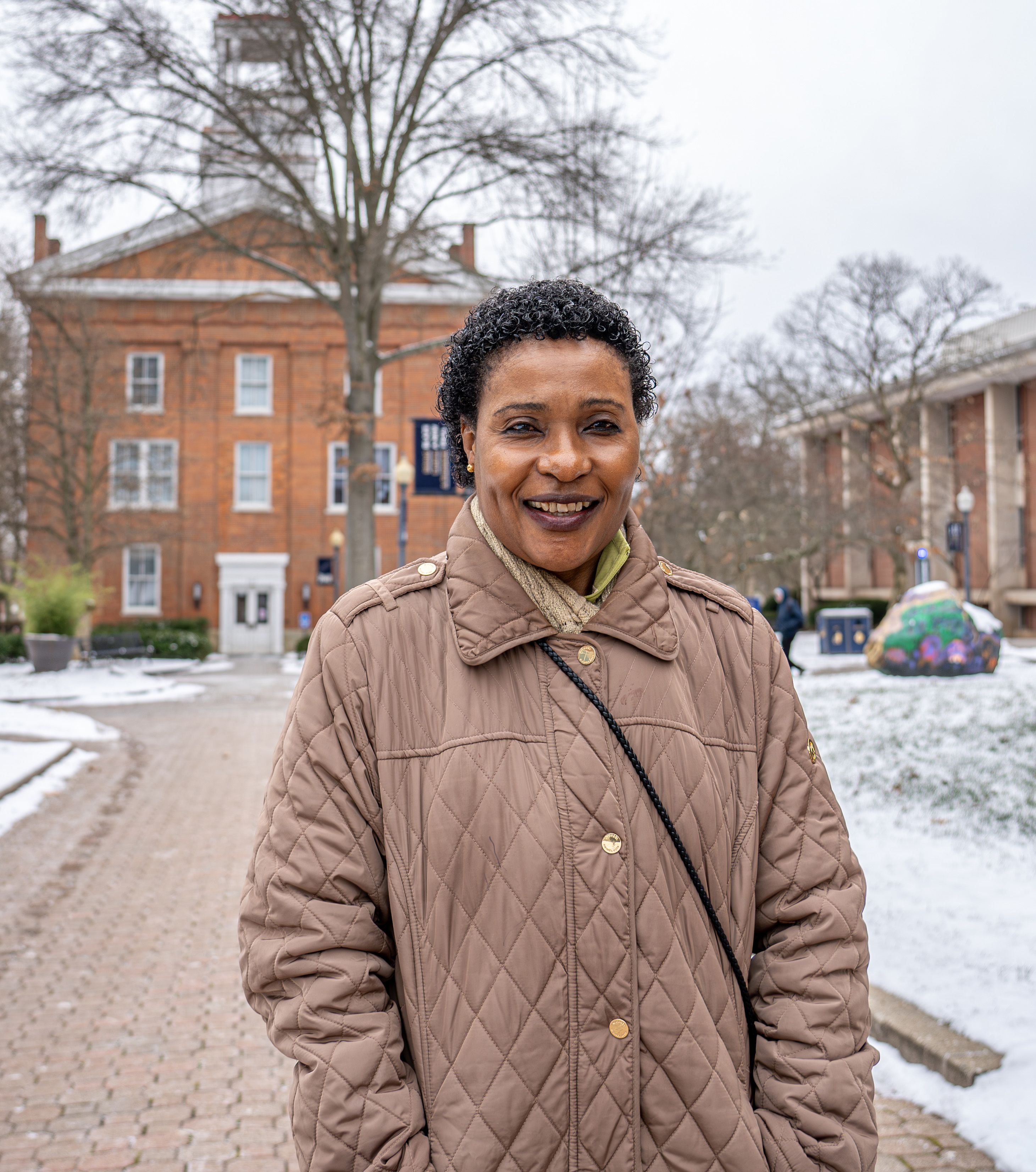
A survivor of the Edi Amin dictatorship, who dedicated her life to improving educational opportunities for Ugandan children spent time with Marietta College students on campus this semester as part of the Schwartz Leader-in-Residence Program.
Joanita Bbaale Senoga, founder of the Circle of Peace School and Circle of Peace International nonprofit organization, met with Leadership, Entrepreneurship and other majors in January, and with faculty and staff during a meet-and-greet.
The Schwartz Leader-in-Residence, facilitated through the McDonough Leadership Program, features bringing an outstanding leader to campus to enhance the leadership knowledge and skills to participating students and employees. The program is named after the late Dr. Stephen W. Schwartz, the longtime Dean of McDonough.
Senoga overcame dire circumstances as a child in Uganda during the Edi Amin regime — including hiding from soldiers for weeks in a cave with classmates — and later attended college to become a teacher. When she saw her students being removed from school because their families could not afford to pay, she decided to start her own in 2009 and founded the nonprofit to support the school, which provides free education to its students.
GI SMITH
 Built with Shorthand